
Neolithic Revolution
First archaeologically verifiable transition to agriculture and settlement.

via Wikipedia: Neolithic Revolution · see source
The Neolithic Revolution, also known as the First Agricultural Revolution, was the wide-scale transition of many human cultures during the Neolithic period in Afro-Eurasia from a lifestyle of hunting and gathering to one of agriculture and settlement. This transition made an increasingly large population possible and is considered humankind's first archaeologically verifiable transition to agriculture. It transformed small, mobile groups of hunter-gatherers into sedentary societies based in built-up villages and towns, radically modifying their natural environment through specialized food-crop cultivation, irrigation, and deforestation.
- field
- Prehistoric cultural and agricultural transition
- known_for
- Wide-scale shift from hunting and gathering to agriculture and settlement in Afro-Eurasia
- period
- Neolithic period, beginning in the Holocene epoch 11,700 years ago (c. 9700 BCE)
- key_region
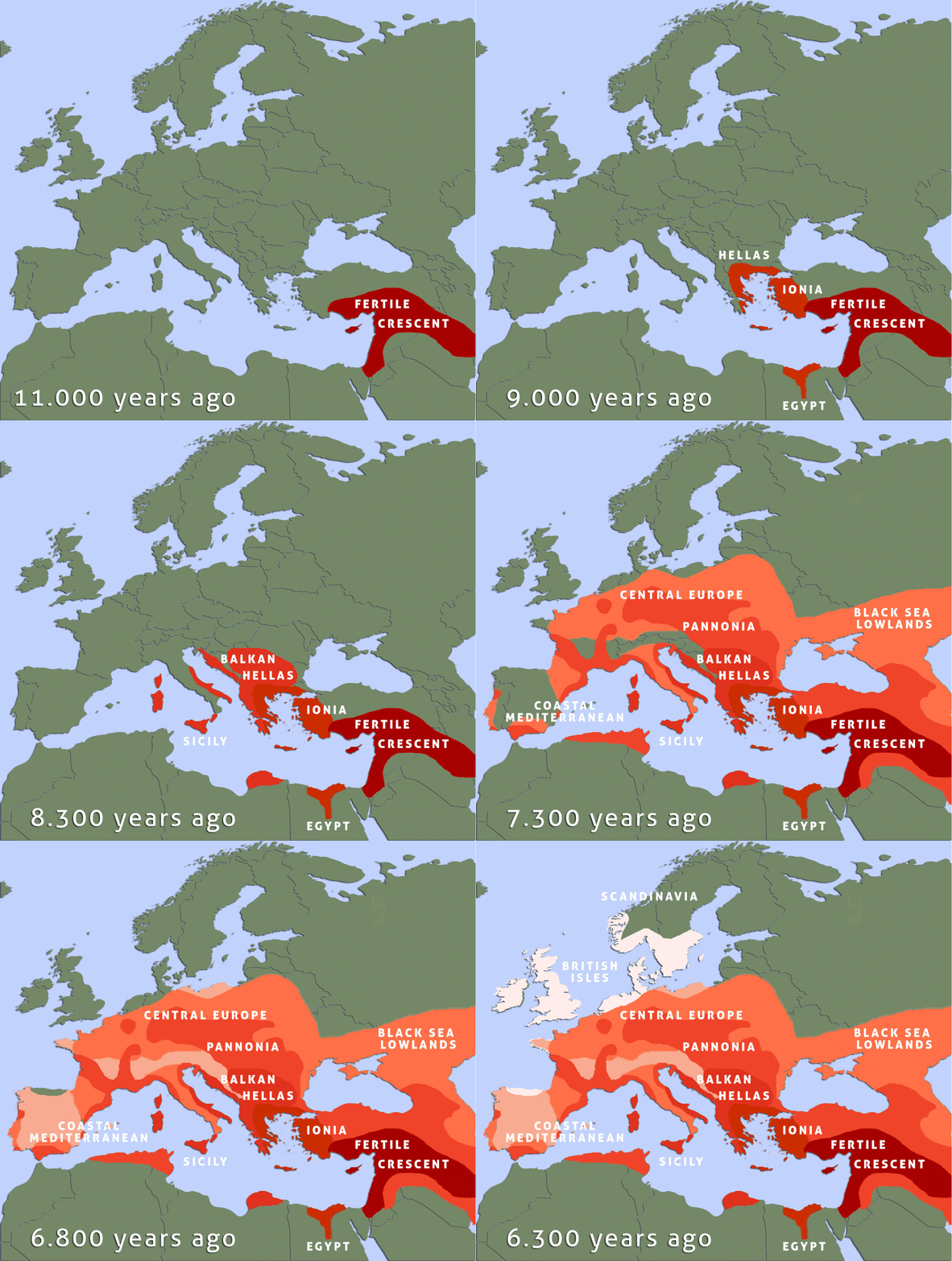
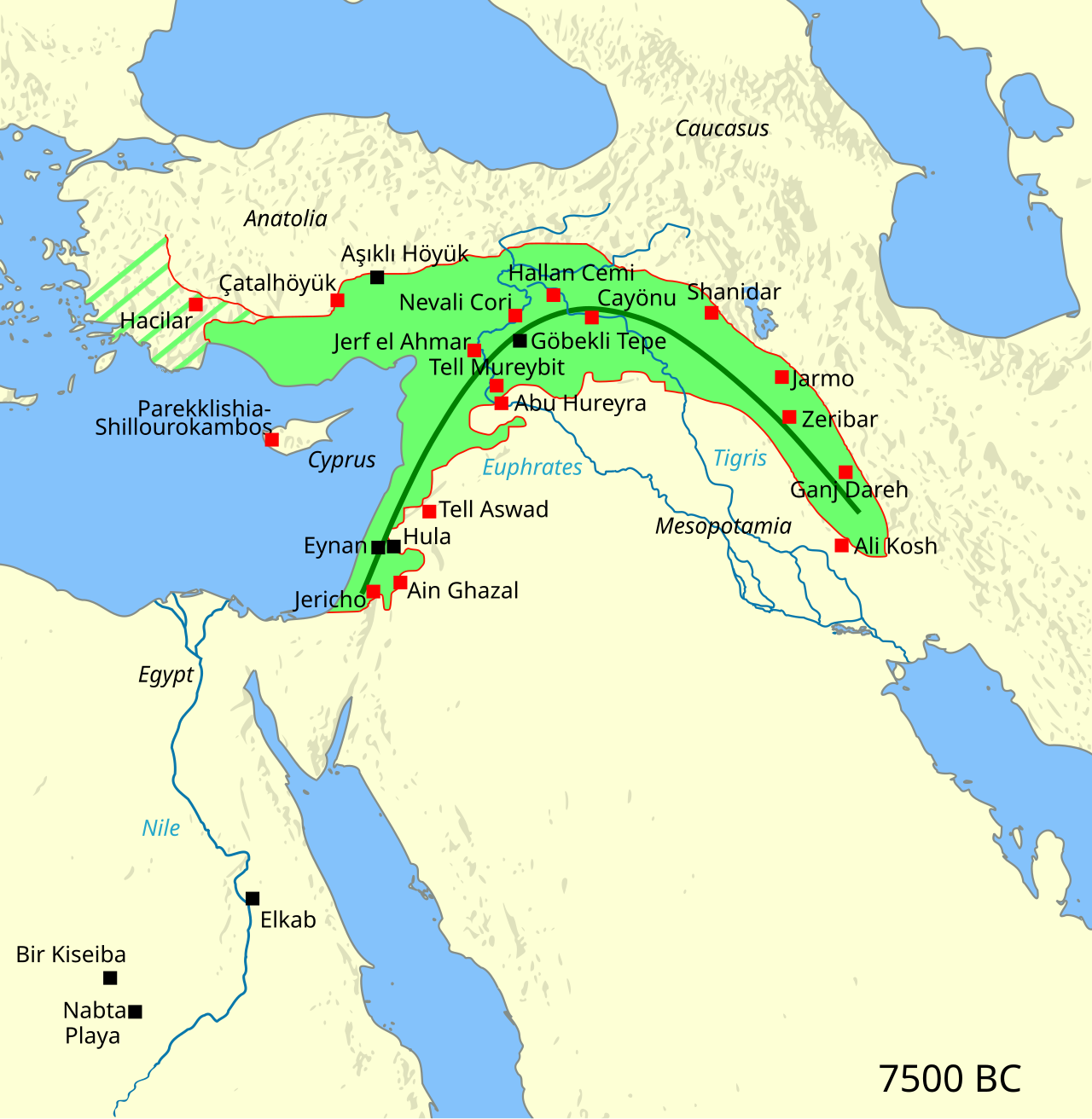
- Afro-Eurasia, with earliest known agricultural sites in the Fertile Crescent
Lore & Background
The term 'neolithic revolution' was invented by V. Gordon Childe in his book Man Makes Himself (1936). Childe introduced it as the first in a series of agricultural revolutions in Middle Eastern history, calling it a 'revolution' to denote its significance and the degree of change to communities adopting and refining agricultural practices. The beginning of this process in different regions has been dated from 9700 to 8000 BCE in the Fertile Crescent, and perhaps 8000 BCE in the Kuk Early Agricultural Site of Papua New Guinea in Melanesia. Everywhere, this transition is associated with a change from a largely nomadic hunter-gatherer way of life to a more settled, agrarian one, with the domestication of various plant and animal species depending on locally available species and influenced by local culture. Archaeological research in 2003 suggests that in some regions, such as the Southeast Asian peninsula, the transition was not linear, but region-specific.
Reader's Guide
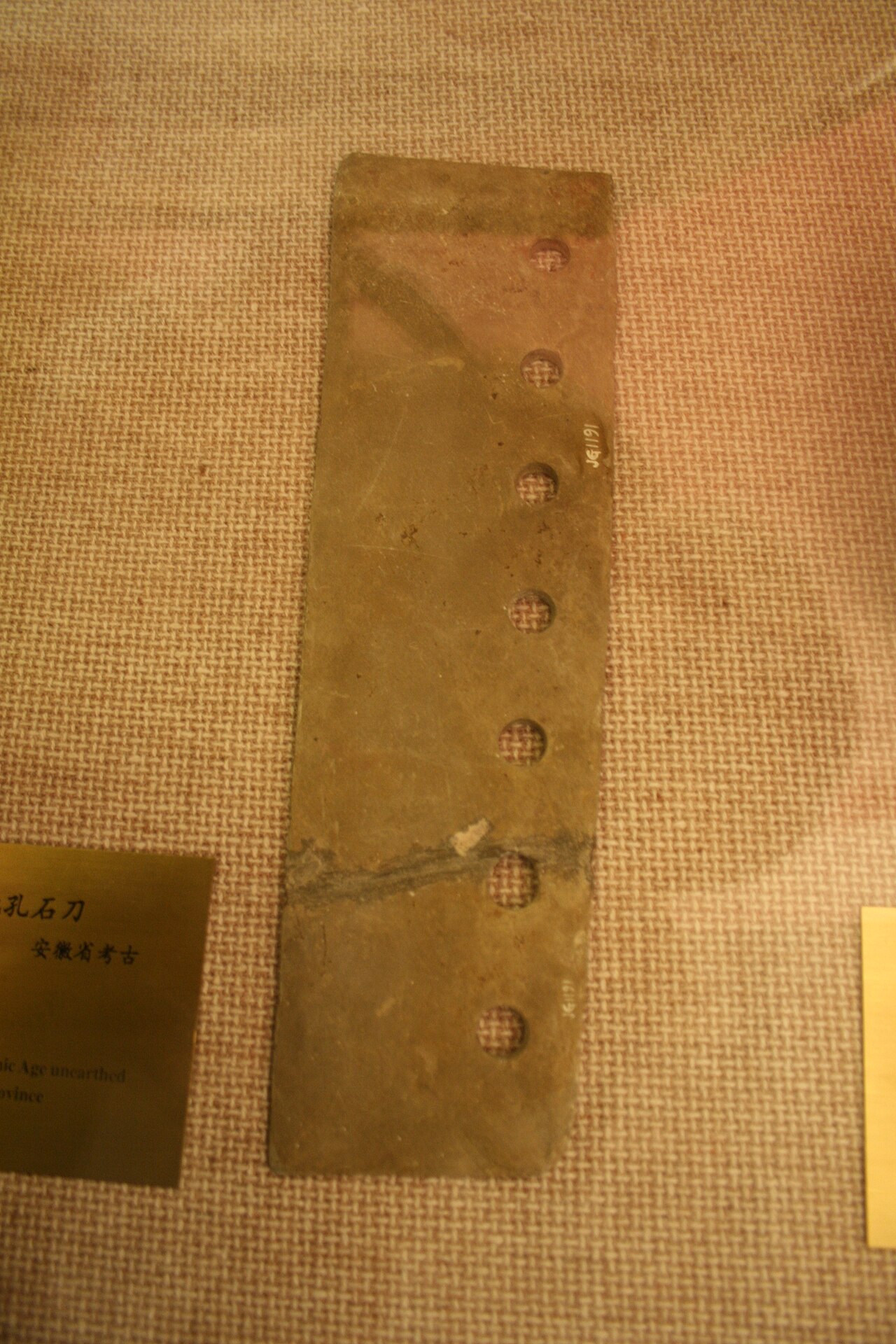
The Neolithic Revolution greatly narrowed the diversity of foods available, resulting in a decrease in the quality of human nutrition compared with that obtained previously from hunting and foraging. However, because food production became more efficient, it released humans to invest their efforts in other activities and was thus 'ultimately necessary to the rise of modern civilization by creating the foundation for the later process of industrialization and sustained economic growth.' The developments of this era—including domestication of animals, pottery, polished stone tools, rectangular houses, and surplus food production—provided the basis for centralized administrations, political structures, hierarchical ideologies, writing, densely populated settlements, specialization and division of labour, trade, non-portable art and architecture, and greater property ownership. The relationship of these characteristics to the onset of agriculture, their sequence of emergence, and their empirical relation to each other at various Neolithic sites remains the subject of academic debate, understood to vary from place to place rather than being the outcome of universal laws of social evolution.
Did You Know?
- The term 'neolithic revolution' was invented by V. Gordon Childe in his 1936 book Man Makes Himself.
- The beginning of the agricultural transition has been dated from 9700 to 8000 BCE in the Fertile Crescent, and perhaps 8000 BCE at the Kuk Early Agricultural Site in Papua New Guinea.
- Archaeological data indicate that domestication of plants and animals started in the Holocene epoch 11,700 years ago, after the last Ice Age.
- The Neolithic Revolution narrowed the diversity of foods available, resulting in a decrease in the quality of human nutrition compared with hunting and foraging.
- The earliest known civilization developed in Sumer in southern Mesopotamia around 6,500 BP, heralding the beginning of the Bronze Age.
From Wandering to Settling: The Birth of Permanent Life
The earliest stirrings toward a settled way of life can be traced to the Levant, where as far back as 12,000 BC the Natufian people began anchoring themselves to one place rather than following game across the landscape. Favourable conditions for hunting, fishing, and gathering cereals created what scholars call a wide-spectrum economy, and the critical presence of water to safeguard a stable food supply gave these communities a reason to stay. By roughly 10,000 BC, that sedentary footing had hardened into genuine agriculture, and the first proto-urban settlements housing several thousand people appeared in Western Asia. The shift was not a single dramatic event but a gradual tightening of the bond between people and place, driven by the practical need to protect an abundant harvest and the social momentum that permanent villages generated. What began as a seasonal convenience became, over generations, the foundation upon which every subsequent layer of complex society would be built.
The First Cities: From Villages to Urban Centres
The Neolithic period in Western Asia, beginning around 10,000 BC, saw the appearance of the earliest proto-urban settlements, each home to several thousand inhabitants. Within a few thousand years, those modest clusters had grown into true cities housing tens of thousands. Uruk, Ur, Kish, and Eridu in Mesopotamia led the way, followed by Susa in Elam and Memphis in Egypt, all reaching that scale by the 31st century BC. The archaeologist Gordon Childe framed this transformation as a two-stage process: first the Neolithic Revolution, which rooted communities in place through agriculture, and then the urban revolution, which amplified dense settlement, occupational specialization, social stratification, surplus exploitation, monumental public architecture, and the emergence of writing. Yet the archaeological record complicates any neat sequence. Dense cities were absent in Egypt's Old Kingdom, Maya populations remained dispersed, the Incas managed without writing (relying instead on Quipus), and in present-day Louisiana, nomadic groups organized over generations to raise earthwork mounds as early as 3400 BC, long before any village existed nearby.
Six Independent Origins: Rethinking Where Civilization Began
For much of the twentieth century, the prevailing view held that civilization was a single invention, born in the Fertile Crescent and radiating outward by cultural diffusion. That model has been thoroughly revised. Modern scholarship now recognizes that complex societies arose independently in at least six distinct regions across both hemispheres: the Fertile Crescent (encompassing Mesopotamia and the Levant), the Nile Valley in Northeast Africa, the Indo-Gangetic Plain, the North China Plain, the Andean Coast, and the Mesoamerican Gulf Coast. Each of these areas developed its own trajectory of city-building, writing or symbolic communication, pottery and metalwork, animal domestication, and layered social hierarchies. The timelines did not align; sociocultural developments unfolded along different timeframes in each region. Moreover, sedentary and nomadic groups continued to interact fluidly rather than forming rigidly separate cultural blocs. The Caral-Supe civilization of coastal Peru stands as a partial exception, possibly relying at first on marine resources rather than agriculture, yet it still fits the broader pattern of independent civilizational emergence.
Agriculture as the Engine of Complexity
Across virtually every recognized cradle, agriculture served as the indispensable engine that powered the leap from small bands to complex, stratified societies. Farmers producing a surplus beyond their own subsistence needs provided the material base that allowed centralized governments, political and religious leaders, and large-scale public works to exist within urban centres. A civilization, in the broadest scholarly sense, is a complex society marked by the development of a state, social stratification, urbanization, and symbolic communication systems that go beyond spoken or signed language—namely writing and graphic arts. Gordon Childe's formulation ties a civilized way of life almost exclusively to conditions generated by agriculture. The Fertile Crescent illustrates this clearly: by 10,200 BC, fully developed Neolithic cultures in the Pre-Pottery Neolithic A and B phases were already in place, and their practices diffused eastward into South Asia and westward into Europe and North Africa. Sites like Göbekli Tepe (9500–8000 BC) and Çatalhöyük (7500–5700 BC) demonstrate how agricultural surplus could fund monumental construction and dense community life long before the first formal cities appeared.
Gallery

Frequently Asked Questions
Who is Neolithic Revolution?
The Neolithic Revolution is the broad historical shift during the Neolithic period in which human communities across Afro-Eurasia moved away from nomadic hunting and gathering and toward farming and permanent settlement. It is recognized as the first archaeologically confirmed transition of humanity into agriculture.
What are Neolithic Revolution's powers/role?
Its central role was transforming small, mobile bands of foragers into settled village and town communities built around cultivated crops. It fundamentally reshaped the natural environment through specialized food production and allowed populations to grow far larger than before.
How does Neolithic Revolution's story end?
The transition did not have a single dramatic finale; rather, it gradually solidified across Afro-Eurasia as agriculture and sedentary life became the dominant mode of human organization. The earliest confirmed farming sites, concentrated in the Fertile Crescent, mark the point where this shift became archaeologically verifiable.
Why is Neolithic Revolution important?
It is regarded as humankind's first verifiable leap into agriculture, making the large, dense populations that later built cities and complex civilizations possible. Without this shift from foraging to farming, the entire trajectory of settled human society would not exist.
When and where did Neolithic Revolution take place?
It began in the Holocene epoch roughly 11,700 years ago (around 9700 BCE) and unfolded across the Afro-Eurasian landmass. The earliest confirmed agricultural sites are found in the Fertile Crescent, though similar transitions occurred independently in other regions as well.
More in Ancient Civilizations 1-15
Related in Ancient Civilizations
Links follow this subject's own source article.
Spotted an error? Know more?
This is a living reference — every entry is fact-audited, and reader corrections feed straight into our audit queue. Suggest an edit · See this site's audit record