Proto-Indo-Europeans
Prehistoric speakers of the reconstructed Proto-Indo-European language.

Kindattu2004 · CC BY-SA 4.0
The Proto-Indo-Europeans are a postulated prehistoric ethnolinguistic group of Eurasia who spoke Proto-Indo-European (PIE), the reconstructed common ancestor of the Indo-European language family. Knowledge of them comes chiefly from linguistic reconstruction, along with material evidence from archaeology and archaeogenetics.
- died
- By early second millennium BC, descendants had spread across Eurasia
- field
- Prehistoric ethnolinguistics
- nationality
- Pontic–Caspian steppe (Eurasia)
- known_for
- Speakers of Proto-Indo-European, ancestral to the Indo-European language family
Lore & Background
The Proto-Indo-Europeans are known only through linguistic reconstruction, archaeology, and archaeogenetics. They are thought to have been a loose network of clans and tribes inhabiting a coherent territory of limited size, not a unified nation or race. Their culture included pastoralism (cattle, horses, dogs), agriculture, the solid wheel, and worship of a sky god *Dyḗus Ph2tḗr.
Reader's Guide
The Proto-Indo-Europeans are significant as the hypothesized speakers of the ancestor language of the Indo-European family, which includes most languages of Europe, Iran, and northern India. Their reconstructed culture provides insights into late Neolithic and Chalcolithic life in the Pontic–Caspian steppe. The term 'Aryan' was historically used for them but is now largely abandoned due to its racial misuse. Their legacy is primarily linguistic, as their descendants spread across Eurasia by the early second millennium BC, forming branches such as the Hittites, Mycenaean Greeks, and Corded Ware culture.
Did You Know?
- Mainstream scholars place them in the Pontic–Caspian steppe across Eurasia.
- The term 'Aryan' was historically used for them but is now largely abandoned by scholars.
A People Defined by Language, Not Blood
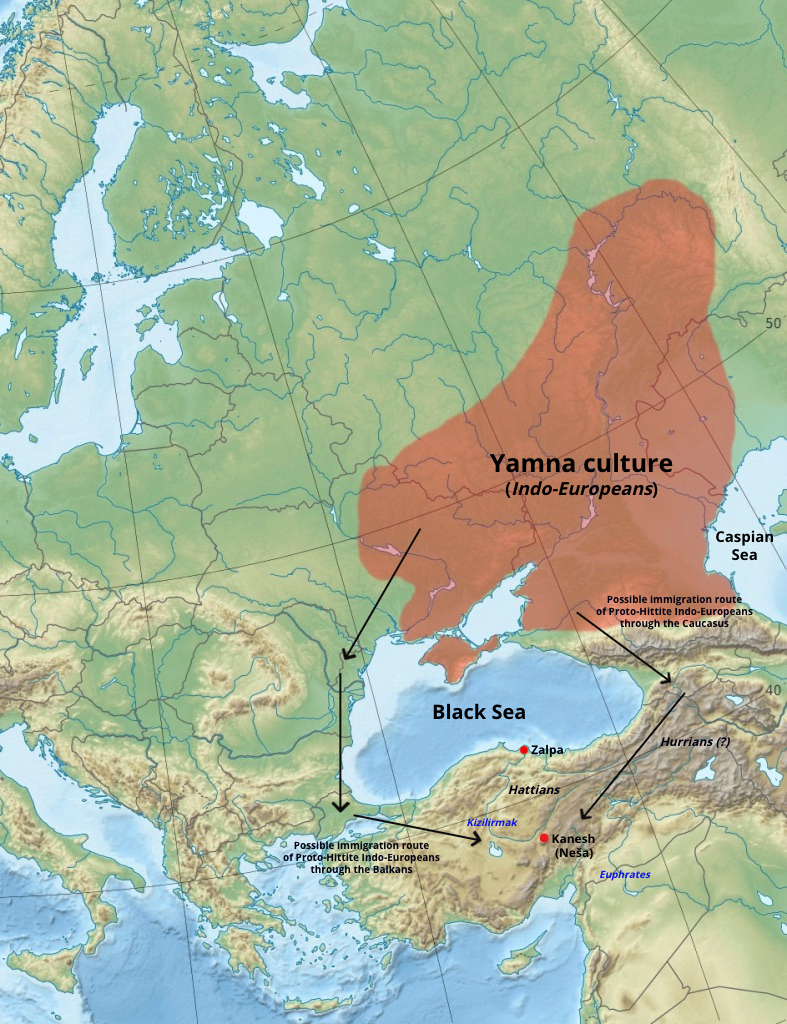
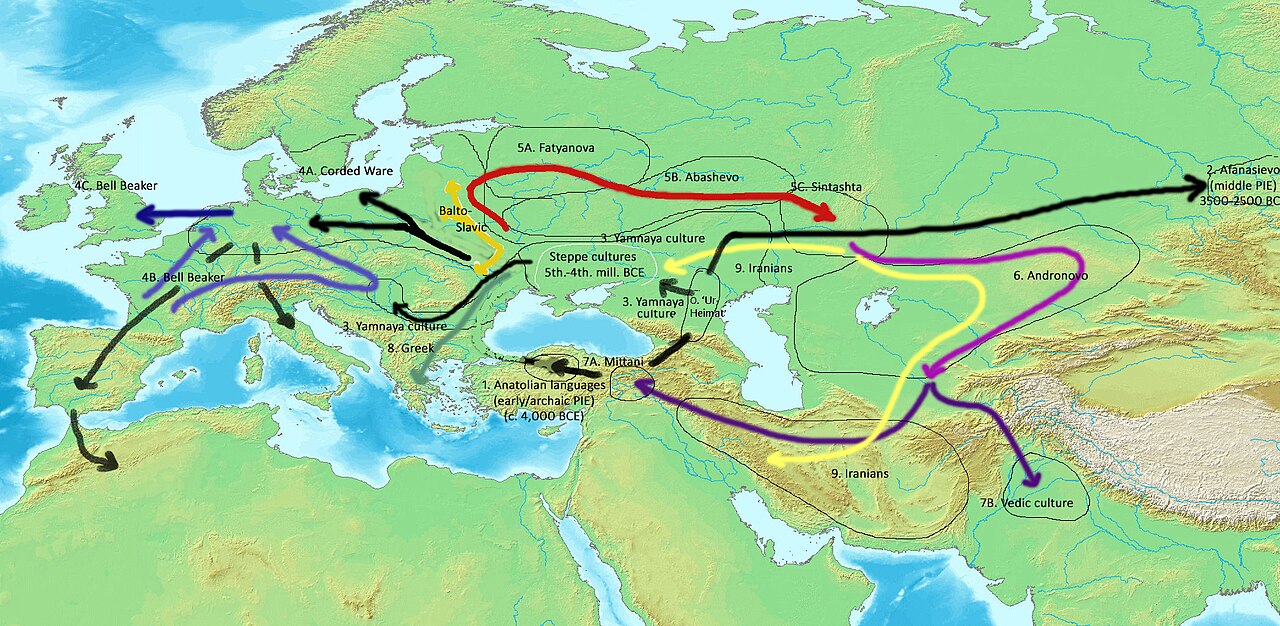
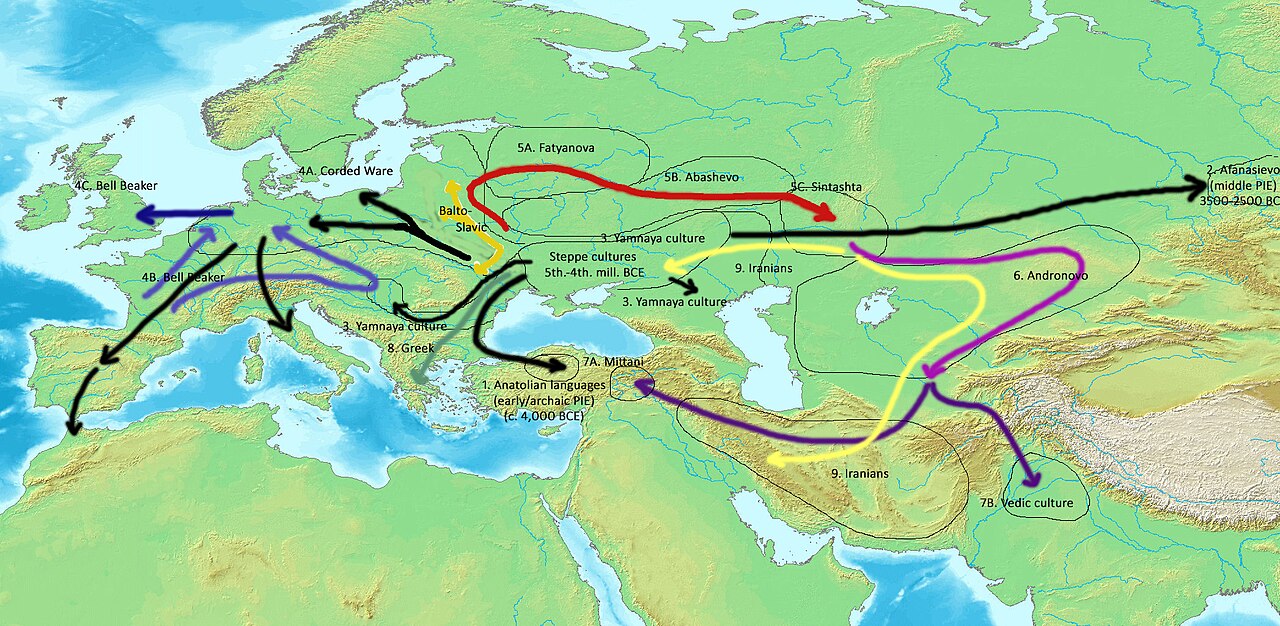
The Proto-Indo-Europeans were never a nation, never a single political entity, and never a racial category. As philologist Martin L. West put it, they were best understood as a loose web of clans and tribes sharing a coherent but limited stretch of territory. What bound them together was a common tongue — Proto-Indo-European — the reconstructed mother of every language in the Indo-European family, from English and Hindi to Spanish and Russian. Our knowledge of this group rests on three pillars: the painstaking reconstruction of their language from surviving descendants, material remains uncovered by archaeology, and genetic data from archaeogenetics. Mainstream scholarship situates them in the vast Pontic-Caspian steppe, a corridor running from northeastern Bulgaria and southeastern Romania through Moldova, southern and eastern Ukraine, the Northern Caucasus, and into the Lower Volga region of western Kazakhstan. Their era spans roughly the Late Neolithic to the Chalcolithic, placing them between 6400 and 3500 BC, though some researchers push the timeline back to the Middle or even Early Neolithic.
A World Reassembled from Words and Wheels
Because no written record survives from the Proto-Indo-Europeans themselves, scholars have had to piece together their world from the vocabulary embedded in the oldest Indo-European languages. The picture that emerges is one of pastoralists who herded cattle, bred horses, and kept dogs, while also cultivating cereals and working the soil with a plow. They built solid-wheeled wagons — a technology that predates the spoked-wheel chariot — and traveled by or across water. Their spiritual life centered on a sky father, reconstructed as *Dyḑus Ph₂tḗr, a deity whose name echoes in Vedic Sanskrit, Ancient Greek, and Latin. Their social fabric was patrilineal, organized around relationships between men. They composed oral heroic poetry built on stock phrases about imperishable fame and the sun's wheel. A 2016 phylogenetic study even traced a folktale — The Smith and the Devil, in which a blacksmith trades his soul for the power to weld any material and then outwits his malevolent patron — back to the PIE period, implying that metallurgy was already part of their cultural toolkit.
From the Steppe to the Edges of the World
By the early second millennium BC, the descendants of those steppe-dwelling clans had fanned out across an astonishing breadth of Eurasia. In Anatolia, their linguistic heirs became the Hittites. In the Aegean, they stood behind the language of Mycenaean Greece. In northern Europe, their cultural signature is visible in the Corded Ware tradition. Along the fringes of Central Asia, the Yamnaya culture carries their imprint, while in southern Siberia the Afanasievo culture marks yet another branch of the same expansion. The reach of their linguistic legacy is even more staggering: every Indo-European language spoken today — spanning dozens of nations and hundreds of millions of speakers — descends, through a long chain of sound changes and grammatical shifts, from the single reconstructed proto-language those steppe peoples once spoke. The term "Indo-European" in modern scholarship can refer either to that original community or to any historical or contemporary people whose language belongs to the family, a distinction that keeps the ancient speakers and their far-flung heirs in a single, if very long, conversation.
Two Centuries of Hunting a Ghost Homeland
The quest to pin down where the Proto-Indo-Europeans actually lived has been one of the most contested adventures in scholarship. Nineteenth-century linguists, armed with nothing but reconstructed plant and animal names — the beech tree, the salmon — and inferences about animal husbandry and horse domestication, split into two camps: a European hypothesis and an Asian hypothesis, each arguing the migration ran in the opposite direction. In the early twentieth century the question became entangled with the discredited ideology of a supposed "Aryan race," a toxic association that still colors certain nationalist debates. A genuine breakthrough arrived in the 1970s, when radiocarbon dating became affordable, tree-ring calibration sharpened the chronology, and political barriers that had kept eastern European and Central Asian sites closed to Western researchers finally began to fall. Pioneers like Marija Gimbutas and Colin Renfrew organized joint expeditions and opened peer-reviewed channels across former borders. The Kurgan hypothesis, anchoring the homeland in the Pontic-Caspian steppe during the Chalcolithic, has since become the most widely accepted model, though it remains far from universally embraced.
Gallery
Frequently Asked Questions
Who are the Proto-Indo-Europeans?
They are a reconstructed prehistoric people of the Pontic-Caspian steppe who spoke the single ancestral tongue behind the entire Indo-European language family. No direct written records of them survive; our picture of them is built from comparing descendant languages, archaeological finds, and ancient DNA.
What is the Proto-Indo-Europeans' role in the broader canon?
They function as the root node from which every Indo-European branch—Hindi, English, Persian, Greek, and dozens of others—eventually diverged. In the encyclopedia's framework, they are the foundational entry that explains why languages on opposite sides of Eurasia share deep structural and vocabulary parallels.
How does the Proto-Indo-Europeans' story end?
By the early second millennium BC the group had already fragmented, with their descendants spreading across a vast stretch of Eurasia and giving rise to the regional language communities we recognize today. Rather than a single dramatic finale, their 'ending' is a gradual dispersal into the ancestor populations of later civilizations.
Why are the Proto-Indo-Europeans important?
They account for the deep kinship linking hundreds of millions of modern speakers across Europe, South Asia, and the Caucasus to one prehistoric linguistic community. Without the PIE reconstruction, the striking parallels between, say, Sanskrit and Celtic would remain unexplained coincidences instead of evidence of shared ancestry.
Where did the Proto-Indo-Europeans live?
The most widely supported model places them on the Pontic-Caspian steppe, the grassland belt between the Black Sea and the Caspian Sea in present-day Ukraine and southern Russia. This location is backed by a convergence of linguistic dating, archaeological material culture, and ancient-DNA analyses.
More in Ancient Civilizations 1-15
Spotted an error? Know more?
This is a living reference — every entry is fact-audited, and reader corrections feed straight into our audit queue. Suggest an edit · See this site's audit record